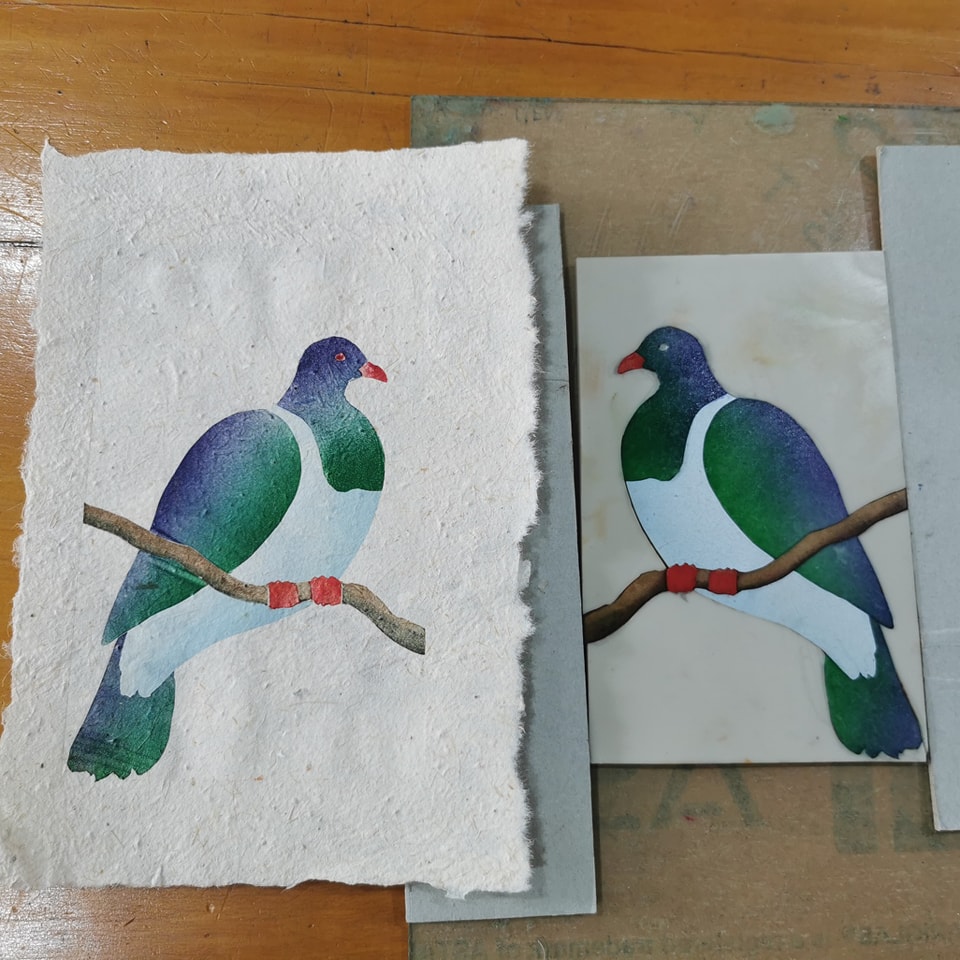

I used the jigsaw puzzle technique for this linocut. As part of our Matariki in Malvern community event, I created this small set of prints to be used as prizes. The star they were focusing on this year was Tupuārangi, which is linked to food and growth above the ground, and which has a strong connection with birds. I decided to do a print of Kererū, our native wood pigeon – I’ve long admired its ample proportions and shimmering colours. I read about how Tupuārangi is associated with Harakeke, our native flax, and was delighted to remember that I had stored away paper which had been made with Harakeke fibres by the Oxford Gallery paper making group.
To make this print I took a single piece of softcut lino and used a craft knife to carefully cut out the bird image to create a jigsaw. Soft cut is thin and rubbery, which makes it easy to cut with a craft knife, and also easy to snugly fit the pieces back together. I then individually inked each piece:
- I used a blended roll of colour for the purple green feathers, and also on the breast. The blend of colour is harder to see on the breast in the photos, but it blends from white to grey shadows.
- I used an eraser to dab brown ink on to the branch sections, and darker brown along the underside of the branch.
- The feet and beak were so small that I dabbed them directly into the red ink which I had rolled out thinly on my inking tray.
I then intersected the inked pieces back together, being careful not to smudge them. I included the uninked border sections as they helped to hold the pieces together. I then placed my paper on top and ran it through my press to print. Finally, I dabbed a tiny bit of red directly onto the print for the eye.
The advantage of this technique over the reduction method which I normally use is that it is quicker, it allows me to print very different colours closely up against one another, and you don’t need to decide on an edition number before you begin. The constraint is that it doesn’t allow for much fine detail or overlapping colours, so you get quite a blocky look. In this case, the blockiness worked well for the image.
The Matariki event was a great success, with hundreds of our community coming together in the depths of winter, to watch kapa haka, share kai and participate in lots of activities together, including printmaking with me!
 Soon-Lee Spicer - Artist